Showing posts with label Study Tasks. Show all posts

Thursday, 12 February 2015

OUGD505 Product Range Distribution - Appropriation and Subversion


For this task, we're asked to see how the designer can re-use someone else's work. Danny presented us a series of original work and the re-appropriation made by other artists. Here some examples:

Marilyn Monroe by Andy Warhol

Re-appropriated by: 
Richard Petitbone
Bansky
David Lachapelle
Elaine Strutevant

But Warhol took this photo to do his work:


I think that the appropriation of someone's design is a part of the evolution of this artwork. In many field, we can find many reproductions (in music, photography, paint…). So it seems natural to me that a graphic designer can do other things from different works like re-appropriation of typefaces, photos, designs… The most important thing is to put your personality on it, it depends of what you want to communicate to people. So it's really important to consider how to equilibrate our own work from what we take to conceive it, to interrogate ourselves about copyrights, what is the originality of our design.

Then we've had a little introduction to fanzine. They are famous especially during the underground/punk culture of the late 70s-80s. Their production was very hand-made as it was created by people who had no skills and no money to produce a real publication. But amazingly new codes were established: use pictures of newspapers, hand-writing titles, etc. One of the most known was 'Sniffin' Glue'.


Then we're proposed to make our own , using a few means such newspapers, glue, paper and scissors. I've decided to make a fanzine about skateboarding life in Leeds. I imagined what kind of articles could be presented on. I've found skateboarders and city photos and I use only hand-writng for titles.


I've made a black and white version:


It was a really enriching experience, I saw that sometimes a few can be efficient for designing rather than using computer means.

Wednesday, 11 February 2015

OUGD505 - Design Thinking Task

☞ For this task, Dany wanted us to think about how to think in design process. Here some slide extracted from the Powerpoint:


The most important thing to retain is : why we have design this thing rather than another one? What is necessary for accomplish my idea? What can I do/learn to reach the perfect concept? For who is destined? The creation process need be to considered and it's as essential as the final realization of my idea. This task refers to the first brief, My Design Process, and it was a good occasion to compare mine from this presented. Then we divided into groups to think about insects (yummy):


The purpose was to find aspects of these bugs that could convince the English to add them to their diet. With my group, we discussed how they can be a good source of proteins, it's healthy, eco-friendly. We asked some questions too: how to cook them? how to present them? their names? (and others I don't really remember). So he've got the idea to make with insects protein bars, energy drinks for athletic men and women essentially commerced in gyms and specialized stores.

The other groups had also good ideas. I liked the one which involved a concept of street food for festivals. This task allowed to me to taste for the first time bugs, a thing a wanted to test for a couple of years (I've already seen TV reports on that) and this could help me for my project for my food campaign.

Tuesday, 6 January 2015

OUGD504 Brief 04 Augmented Design - Study Task 11

☞ Project Rationale

- Purpose/reason of the campaign : The reason of my website campaign is to let know people that it exists and let draw them to watch the videos.

- Audience/Message/Tone of voice :


Format : printed advertising campaign (bildboards, magazines, newspapers…) with augmented design dimension.

Materials & Budget : Paper, Digital supports : my objective for this brief is to make 3 supports : a little poster, a flyer and a sticker which would be dispatched.

Flyer

Poster

Stickers

Total price is about £200 for the whole communication.

Placement/distribution : I still believe that public areas placement would be great : streets, restaurants, subways, etc. I have to target my audience but there's a possibility that other people could be interrogated and interested by the concept.

Must do's : be funny ; attract viewer's curiosity

Must not's : use video extract ; be too explicit

Time-frame : as the purpose is to reveal the existence of my website for launching it, I think there's no need to make my campaign last. The ideal time-frame in my view would be 2 months. This is enough for being seen by the audience which tends to zap information quickly.

Thursday, 18 December 2014

OUGD504 Brief 04 Augmented Design - Study Task 13

Print Finishes

There are many creative possibilities for print :

Varnishes


A varnish is a liquid shellac or plastic-like put on a printed piece like a layer or clear ink, varnish adds a glossy, satin or matte finish. Part of the printing or finishing process, varnish is applied like a final layer of ink after a piece is printed. It may be clear or tinted.
Glossy finish

Matte finish

Spot varnish
This is a special effect that puts an overprint varnish only on specific areas of a printed piece, spot varnish is often used to make a photograph pop off the page, highlights drop caps, or to create texture and subtle images on the page. The term spot varnish can refer to more than just clear ink or resin varnish but also to the spot application or Ultra-violet (UV) coatings or Aqueous (AQ) finishes.


Lamination
This is one of the more expensive but more accurate types of prepress proofs are laminate proofs. These full-color proofs are created from the negatives used to make the printing plates. Each separation is transferred to a separate sheet and the layers are fused or laminated together to give an extremely accurate representation of the final printed piece.

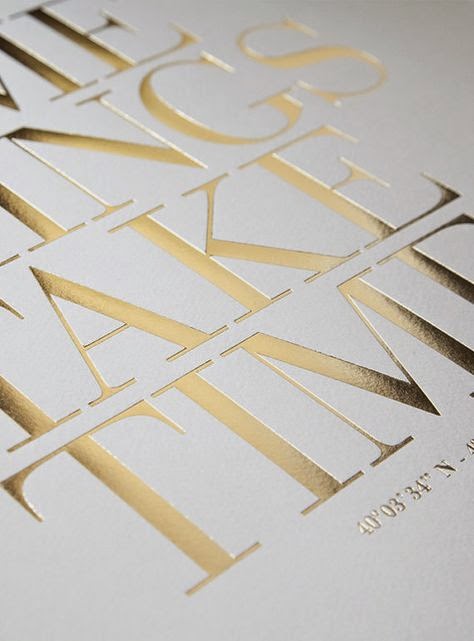
Foil Stamping

Foil stamping is the use of a malleable metallic material applied to the print surface by using heat and pressure. Foil stamping is the application of foil, a special film-backed material, to paper where a heated die is stamped onto the foil, making it adhere to the surface leaving the design of the die on the paper. Foil stamping can be combined with embossing to create a more striking 3D image.


Embossing

The creation of a raised three-dimensional design or image on paper is known as embossing. Heat and pressures reshapes the surface of the paper to create the image. Single, multi-level, beveled, and sculptured are the styles of embossing. Embossing can be done on plain paper (blind embossing) or combined with ink, images, or foil for special effects. 
Embossing is a way to add visual and tactile interest to paper. It adds texture, value, (and color if using ink or foil embossing) and perhaps other elements of design depending on the type and placement of the embossing.

The entire surface of the paper can have an embossed finish. Logos, lines, and other images may be embossed on portions of the page. Embossing is done during the printing and finished stage of a design (or during the papermaking process). Embossing machines and individual embossing stamps are also popular in paper crafting and scrapbooking. The look of embossing can also be achieved using embossing powders or inks which can be applied to paper to create a raised design.


Debossing (or Letterpress) : it's the opposite of embossing. Traditionally, the letterpress technique was used only for applying ink on a page as a form of relief printing and usually only for text. But it has evolved to also include pressing logos and other design elements directly into the paper substrate.


Thermography

Thermography uses a special powder which is added to the document with it adhering to the ink printed on the paper. After removing the excess powder the printed piece is heated and the powder and ink mixture dries to form a raised effect on the paper.


Die Cutting

Die-cutting is a process used in many different industries to cut a thin flat material (in our case, paper) into a specific shape using a steel cutting die.  It can be used to punch out a decorative shape or pattern to incorporate within a larger piece, or it can be used to create the main shape of an object by cutting the entire sheet of paper in an distinct/designed way.  More simply put: for us it’s way of making a hole in paper in a desired shape using the same presses that we use for letterpress printing.


Laser Cutting

Laser cutting is a non-contact process which utilizes a laser to cut materials, resulting in high quality, dimensionally accurate cuts. The process works by directing the laser beam through a nozzle to the workpiece. A combination of heat and pressure creates the cutting action.  The material melts, burns, vaporizes, or is blown away by a jet of gas, leaving an edge with a high-quality surface finish. 


Screen Printing
Screen printing (also known as silk screening) is one of the oldest methods of printmaking, with examples dating back to the Song Dynasty in China.  The process involves creating a stencil of an image on a screen of porous mesh, traditionally made of silk.  A roller or squeegee is used to pull paint-like ink over the stencil, forcing it through the mesh onto the paper being printed.  Unlike the inks used in some other forms of printing, screen printing ink sits right on the surface of paper, resulting in incredibly rich, vibrant color.

Wednesday, 17 December 2014

OUGD504 Brief 04 Augmented Design - Study Task 12

☞ Answer to the following questions in order to guide your criticality and creative engagement with augmented strategies :

- What is the potential of interactivity in print ? The potential of interactivity in print is to bring a new dimension in a static support. It can be interesting for viewers as the company to have a direct contact. Interactivity can have also say things that can't be shown in one single image or message. It creates a new kind of suspense, asks questions… So the message is like a staging, with a scenario, moving actors and events.

- Can augmented design help draw people to your website ? My website is a video website. I think it's important to say that is this kind of website but in my campaign, I haven't to show video extracts from the website, I find it could present non-sense pictures. The purpose is to do something funny like parodies and include the philosophy aspect of my website.

- Is it all just a bit gimmicky ? Or, are there opportunities ? What kind of interactivity would be effective for my campaign ? Thinking about including augmented design in my campaign is useful. I thought about a concept which can take account viewers in subways : there are many who travel every day and sometimes for a long time. If they see my augmented ad and use their smartphone to access my website, it can be great, because they'll take it with them and view videos for their distraction in the subway.